Saturday, March 30, 2019

Chipotle's stock is having its best quarter ever—here's how to play it

Chipotle's stock is sizzling.

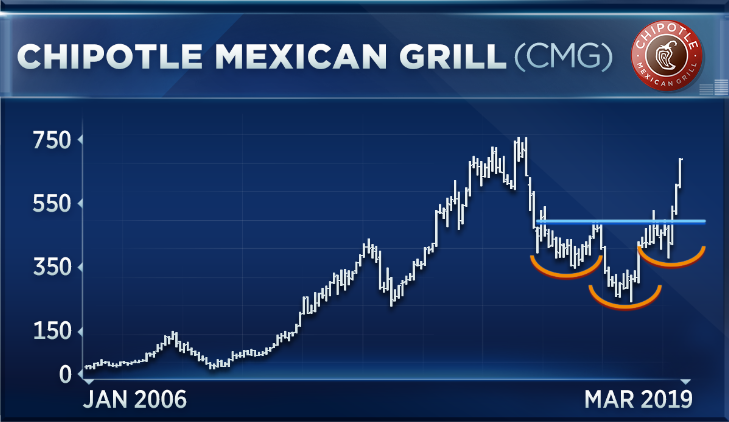
Shares of the fast-casual chain are on pace for their best quarter ever, up about 60 percent year to date and some 80 percent from the December lows.

On Tuesday, the stock reached its highest level since 2015.

Given the surge, market watchers tell CNBC it's not yet time for investors to take advantage of Chipotle's red-hot rally.

Erin Gibbs, research analyst at S&P Global Market Intelligence, said Tuesday that while the company's double-digit profit growth, expansion plans and mobile-ordering boost are generally promising, the stock has run too much for her taste.

"It's a little pricey at this point," she told CNBC's "Trading Nation." "Its valuations are very extended, and ... if they don't beat these really high expectations, if they don't hit every single number, I'm worried about the negative part and [expectations] coming down. And we already know from last year [that] health concerns, data breach, anything can send this stock plummeting. So I'd like to see an entry point closer to about $615. That would make me feel more comfortable."

Frank Cappelleri, chief market technician at Instinet, was also somewhat cautious, telling CNBC in the same segment that the stock has looked "extended" since mid-January.

Cappelleri noted that if Chipotle's stock can break out of its current inverse head-and-shoulders pattern, it could rally into the $700s. But with the current reading on its relative strength index, which tracks buying and selling pressure, he said he'd also advise investors to wait for a better entry point.

"The RSI is at 86, and that is the second-highest level we've seen in its entire history," he said. A reading over 70 indicates that a security is overbought.

"At this point, the stock has done nothing wrong except go up," Cappelleri said. "I think it pauses, and we take advantage of that and buy it on weakness."

Shares of Chipotle made a new 52-week high of $692.75 a share on Tuesday, closing slightly lower at $688.82. They were up 1.7 percent in Wednesday's premarket. Shares are up nearly 110 percent in the last 12 months.

Disclaimer

Gold is expected to trade higher today: Angel Commodities


Angel Commodities' report on Gold


Last week, spot gold prices rose by 0.8 percent after downfall in the US Dollar over dovish comments by the FED. However, better than expected U.S. economic data helped Dollar rebound which in turn capped gains for the yellow metal. The U.S. Federal Reserve gave up all plans to hike interest rates in 2019, signalling towards an end of their monetary tightening policy which weighed on the Dollar in turn supporting Gold. However, the gains were capped by the uptrend in the U.S. Dollar after applications for unemployment benefits reduced significantly last week coupled with factory activity in the mid-Atlantic region rebounding sharply this month after sharp falls.


Outlook


Expectation of dovish stance by FED might weigh on the US Dollar and in turn support Gold. Markets will have an eye on results of the U.S. Federal Reserve's policy meeting later in the day. On the MCX, gold prices are expected to trade higher today; international markets are trading higher by 0.20 percent at $1321.45 per ounce.


For all commodities report, click here


Disclaimer: The views and investment tips expressed by investment experts/broking houses/rating agencies on moneycontrol.com are their own, and not that of the website or its management. Moneycontrol.com advises users to check with certified experts before taking any investment decisions. Read More First Published on Mar 25, 2019 12:46 pm

Monday, March 25, 2019

Three "Best in Breed" Stocks for Fast, Bullish Profits

This site uses Akismet to reduce spam. Learn how your comment data is processed.

Chris JohnsonChris Johnson

On Friday, I published three picks for you that I think will yield market-crushing returns in a hurry.

What could be better than three winners?

How about three more winners…

My "Best in Breed" stock screener has picked out the top performers in a market that, as of today, is growing stronger by the minute.

This is the perfect way to tap all the bullish power the stock market is offering us right now, with none of the guesswork.

Let's take a look…

Join the conversation. Click here to jump to comments…

Chris JohnsonChris Johnson

About the Author

Browse Chris's articles | View Chris's research services

Chris Johnson is a quant - he's obsessed with building and perfecting mathematical models that allow him to predict, with startling accuracy, the direction of the markets, entire sectors, and individual securities. For the last year, he's been researching and building a new system that lets him move swiftly in and out of the hottest stocks in the market for life-changing gains - entirely on his own terms. The results of his newly-minted Night Trader system are nothing short of amazing.

Chris also contributes to Money Morning as the Quant Analysis Specialist.

… Read full bio

Friday, March 22, 2019

Biogen heads for the worst day in a decade after ending trial for blockbuster Alzheimer's drug

Shares of Biogen plummeted Thursday after the company halted the trial of Alzheimer's disease drug aducanumab, which it was developing in partnership with Japanese pharmaceutical company Eisai.

Biogen's stock tanked 29 percent Thursday, on pace for its worst day since August 2008 because the drug was expected to be a blockbuster. Biogen is one of the largest biotechs in the world with a $63 billion market value.

The company said in a statement that the decision to stop the phase 3 trial is based on an independent group's analysis showing that the trials were unlikely to "meet their primary endpoint." The recommendation to stop the studies was not based on safety concerns, Biogen said.

Expectations had been high for aducanumab as Goldman Sachs analysts had projected at one time that sales of the drug could reach $12 billion.

"This disappointing news confirms the complexity of treating Alzheimer's disease and the need to further advance knowledge in neuroscience," said Michel Vounatsos, chief executive officer of Biogen, in a statement. "We are incredibly grateful to all the Alzheimer's disease patients, their families and the investigators who participated in the trials and contributed greatly to this research."

Analysts weighed in after the announcement shocked the Street.

"This was the largest opportunity and the most high-profile pipeline event for trial events in the entire space, you could argue, let alone for Biogen," said Jared Holz, a health-care analyst at Jefferies. "We've been talking about this for several years with an expectation we'd get a readout in 2020. There was obviously a chance you could have a futility analysis in 2019, but investors thought we were past that point."

"All you are left with now is a value stock – it's essentially Gilead, a cheap stock with an unproven pipeline and a company that will be more reliant on M&A," Holz added.

Biogen designs therapies for neurological and hematological disorders, ranging from multiple sclerosis to hemophilia. Though Biogen remains a key player in the treatment of multiple sclerosis, mounting competition had forced the Cambridge, Massachusetts-based company into new areas such as Alzheimer's.

William Blair downgraded Biogen to market perform from outperform following the news.

"We expect Biogen's stock to trade down to $240-260 (~20%) on this negative news, and we cannot find any near term catalysts that would help the stock recover back above $300," SVB Leerink analyst Geoffrey Porges said in a note.

Morgan Stanley analyst Matthew Harrison called the discontinuation of the trial "a major negative."

— CNBC's Thomas Franck and Michael Bloom contributed reporting

Tuesday, March 19, 2019

Oracle (ORCL) Q3 2019 Earnings Conference Call Transcript

Logo of jester cap with thought bubble with words 'Fool Transcripts' below it

Image source: The Motley Fool.

Oracle (NYSE:ORCL) Q3 2019 Earnings Conference CallMarch 14, 2019 5:00 p.m. ET

Contents: Prepared Remarks Questions and Answers Call Participants Prepared Remarks:

Operator

Welcome to Oracle's third-quarter 2019 earnings conference call. Now I'd like to turn today's call over to Ken Bond, senior vice president.

Ken Bond -- Senior Vice President, Investor Relations

Thank you, operator. Good afternoon, everyone, and welcome to Oracle's third quarter fiscal-year 2019 earnings conference call. A copy of the press release and financial tables, which includes a GAAP to non-GAAP reconciliation and other supplemental financial information, can be viewed and downloaded from our Investor Relations website. On the call today are Chairman and Chief Technology Officer Larry Ellison, and CEO Safra Catz, and Mark Hurd.

As a reminder, today's discussion will include forward-looking statements, including predictions, expectations, estimates or other information that might be considered forward-looking. Throughout today's discussion, we will present some important factors relating to our business, which may potentially affect these forward-looking statements. These forward-looking statements are also subject to risks and uncertainties that may cause actual results to differ materially from statements made today. As a result, we caution you against placing undue reliance on these forward-looking statements, and we encourage you to review our most recent reports, including our 10-K and 10-Q, and any applicable amendment for a complete discussion of these factors and other risks that may affect our future results or the market price of our stock.

And finally, we are not obligating ourselves to revise our results or publicly release any revisions to these forward-looking statements in light of new information or future events. Before taking questions, we'll begin with a few prepared remarks. And with that, I'd like to turn the call over to Safra.

Safra Catz -- Chief Executive Officer

Thanks, Ken. Good afternoon, everyone. I'll first go over Q3 results before moving on to guidance. I'll then turn the call over to Mark and Larry.

As in prior quarters, I'll review our non-GAAP results using constant dollar growth rate, unless I say otherwise. Total Cloud Services and License Support revenue for the quarter was $6.7 billion, up 4% in constant currency, and now accounts for nearly 70% of total company revenue, largely recurring revenue. As in past quarters, we're seeing robust double-digit growth rates for total cloud revenue in all regions, with especially strong growth in Asia Pacific. In terms of product categories, ERP grew in the mid-30s and the verticals grew in the high 30s.

Our software business, which is the totaling of Cloud Services and License Support revenue with Cloud License and On-Premise License revenue is 82% of total revenue and it grew 3% in constant currency. Our software business has remained extremely stable and resilient as we have made the transition to faster-growing SaaS business that entailed trading nonrecurring upfront license revenue for recurrent long-term subscription revenue. Through adoption of autonomous database and OCI, we're now shifting the focus for our infrastructure business to the cloud. As a percentage of our total software business, cloud is now more than double what it was just three years ago and provides us with the ability to accelerate overall software revenue growth as this mix shift continues.

GAAP applications total revenue were $2.8 billion, up 7%, and GAAP infrastructure total revenue were $5.1 billion, up 2%. The gross margin for Cloud Services and License Support was 86%, essentially the same as last year with continuing improvement in SaaS gross margins, stability in software support growth gross margins and continued investment in Oracle cloud infrastructure. Once our cloud business is at scale, I expect our gross margins will go significantly higher. Total revenue for the quarter was $9.6 billion, up 3% from last year.

Non-GAAP operating income was $4.3 billion, up 5% from last year, and the operating margins was 44%, up from 43% last year. This quarter last year was greatly impacted by the change in the U.S. tax book, so comparing the GAAP numbers is not very meaningful after pre-tax income. The non-GAAP tax rate for the quarter was 20%, up from 16% catch-up rate last year, and non-GAAP EPS was $0.87 in USD, and up 12% in constant currency.

This quarter, the GAAP tax rate was 11% and GAAP EPS was $0.76. Operating cash flow over the last four quarters is $14.8 billion. Over the last four quarters, capital expenditures were $1.6 billion and free cash flow was $13.2 billion, down 1% due to timing differences of tax payments and working capital items. We have more than $40 billion in cash and marketable securities.

The short-term deferred revenue balance is $8 billion, up 5% in constant currency. The remaining performance obligations, or what I'll refer to as contract backlog, will be in the Q, and is now $31.5 billion, of which approximately 62% will be recognized as revenue over the next 12 months. Since we remain committed to returning value to shareholders through acquisitions, internal investments and a return of capital with stock repurchases and dividends, this quarter, we repurchased 206 million shares for a total of $10 billion. Over the last 12 months, we repurchased 728 million shares and reduced the absolute shares outstanding by nearly 16%.

And the Board of Directors increased the quarterly dividend 26% from $0.19 to $0.24 per share. Turning to currency. I expect the strengthening U.S. dollar will continue with a currency headwind of 3% for Q4 revenue and a $0.03 headwind to earnings per share.

OK. So with that, let me turn to the guidance. So for Q4, total revenues are expected to grow 1% to 3% in constant currency and zero to negative 2% in U.S. dollars.

Non-GAAP EPS in constant currency is expected to grow between 15% to 19%, and be between $1.08 and $1.12 in constant currency, so we will deliver double-digit non-GAAP EPS growth for fiscal year 2019. Taking into account the $0.03 currency headwind, non-GAAP EPS for Q4 in USD is expected to grow between 12% and 16%, and be between $1.05 and $1.09 in USD. My EPS guidance assumes a base tax rate of 20%. However, onetime tax events could cause actual tax rates for any given quarter to vary from our base tax rate, but I expect that in normalizing for onetime tax events, our tax rate will average around 20%.

And with that, I'll turn the call over to Mark for his comments.

Mark Hurd -- Chief Executive Officer

Thanks, Safra. Thanks. Solid quarter for us, from top to bottom. Total revenue was up 3% in constant currency with Cloud Services and License Support, up 4% and EPS 12% -- plus 12% in constant currency.

In our apps ecosystem, we continued our momentum, growing at 7%, and that was an acceleration for us, and over $11 billion in trailing 12-months revenue and 92% of that is now recurring. We continue to grow revenue faster than market, and we have an enormous opportunity ahead of us in ERP and HCM. In terms of SaaS revenue and bookings, Fusion apps were up 35%. By the way, our overall ERP and HCM annualized SaaS revenue is now $2.8 billion, and that's up in the mid-20s.

Turn to Fusion apps, 35% up, Fusion ERP with -- revenue was up 47% organically. NetSuite revenue was up 28%. Bookings were up actually even higher in the mid-30s. Our vertical revenue was up 38%, and our annualized revenue in the verticals is now over $800 million.

I'm going to read you a quick quote from IDC, and I have to read it precisely or I'll get cards and letters. So let me just make sure I do this exactly as it's written. "Per IDC's latest annual market share results, Oracle is the No. 1 enterprise applications vendor in North America based on market share and revenue, surpassing Salesforce.com and SAP." We've seen this momentum building, so this is not any surprise to us, but I think it's always better when you can see it in real numbers from somebody other than us.

Let me switch briefly to infrastructure. Our GAAP tech ecosystem is $21 billion on a trailing 12-months basis and Q3 was up 2%. In Autonomous Database, our momentum continues to build. We now have 4,000 new trials that were added in Q3 alone, nearly 1,000 paying customers.

We're adding many new customers and we're seeing great pull-through and with 20% of our autonomous data warehouse trials also using analytics. We now have over 35 referenceable customers and we expect to be greater than 100 soon. Cloud and customer revenue was up triple digits for the fourth consecutive quarter. So overall, a solid quarter, as we hit our revenue targets and saw a 12% EPS growth.

The strength of our bookings growth along with climbing renewal rates gives me the confidence that our cloud apps business is only going to strengthen from here and going forward, given the visibility we have into the revenue backlog, which Safra touched on a bit earlier. Looking forward, I do expect FY '20 revenue growth will be higher than FY '19. And EPS this year will be certainly -- grow double digits, as Safra mentioned. I'm going to give you a few customer wins as well, try to give you a flavor for what happened in the quarter for us.

Now most of these didn't affect our revenue, most of these obviously are all really bookings that occurred in the quarter, but I thought I'd give you some context about some people in our user base as well as outside our user base. So for example, Tromp Group in the Netherlands E-Business Suite migration; MasterBrand Cabinets in the U.S. in E-Business Suite migration; thyssenkrupp in Germany in E-Business Suite migration; Willis Towers Watson E-Business Suite migration. I gave you those, just a few of those examples.

Those are core, sort of, E-Business Suite, Black & Veatch was another one engineering company, core, sort of, E-Business Suite customers as we see this acceleration of our user base move into the cloud. Got a couple PeopleSoft ERP migrations, Amica Mutual in the quarter, Depaul University. And then a slew of wins again. And I referenced that a lot of the ERP user base that's out there today is outside of our user base or even our traditional on-premise competitor from, if you will, the old days.

ON semiconductor, nice win in the quarter. Packaging Corporation of America, again, outside of our user base for the quarter. Eaton, leather manufacturer. [Inaudible] in the Netherlands.

I could go on, which, in the sake of time, I won't, although I mentioned Ashford Hospitality. These are, again, outside our user base that are brand-new customers to Oracle in the area of ERP. In HCM, Abu Dhabi Airports; ADT; Alorica; BLOM BANK; Great Canadian Gaming. We had a really nice win in the company called the Nova Healthcare.

This again was not inside our user base. These were attritional Lawson customer, where we actually get multipillar ERP back-office and HCM connected together. So anyway, I'll stop there in the sake of time, but just to really, again, very impressive set of customers and a good mix of net new logos as well as movement from our user base. We had a pretty good quarter and it was some really quality names on the platform side.

Fair Isaac, Generali insurance services in Italy; JOANN Stores; Trans Italia; Unicorp, I mean some really nice beginnings of what you're seeing as we move toward Gen 2 cloud and Autonomous Database. I did want to make a couple of quick comments in our growing relationship with The Gap. So it was a global retailer. It's, I think, most of you know with revenue of greater than $16 billion, and we've been working with The Gap in their transformation to what's really a multi-cloud environment but using many, many Oracle Technologies, may include really everything we got SaaS, PaaS, delivering innovation, reliability and scalability at every turn.

And as part of even the things they're using in the private cloud, those are all really enabled by Exadata, and we're really thrilled to be Gap's strategic partner in their efforts to spin up their new retail brands and stores faster. And so that's the few quick wins for the quarter. So overall, good solid quarter for us on the income statement side, but also in the quality of these bookings that we're describing or that I have been describing. And with that, I'll turn it over to Larry.

Larry Ellison -- Chairman and Chief Technology Officer

Thank you, Mark. Oracle's future rests on two strategic businesses: cloud applications and Cloud Infrastructure. The growth in our cloud applications business has been driven by our Fusion Suite and NetSuite. Both the Fusion Suite of applications and NetSuite are growing very, very rapidly, and Mark gave you the numbers.

As the names imply, both Fusion and NetSuite are integrated suites of applications, including sales, service, human resources, financials, supply chain and manufacturing applications. No other cloud services provider has such a comprehensive suite of applications covering both the front office and the back office. Most customers want their cloud services provider to make their applications work together. Customers do not like to be responsible for the complex process of integrating lots of different applications, running on lots of different vendors' clouds.

We think our integrated suite approach to the cloud applications business is a primary reason for the very rapid growth in our cloud applications market share. The introduction of our Gen 2, a highly secure infrastructure, featuring the Oracle Autonomous Database has been very well received. During Q3, we had nearly 1,000 paying Autonomous Database customers and over 4,000 active trials. Our infrastructure technology is highly differentiated from AWS.

Each one of our cloud computers has a separate security processor and memory to insulate customers from intruding upon each other. And it also makes our cloud control code inaccessible by customers. No other cloud services provider offers this kind of protection across their entire public cloud. The Oracle Autonomous Database is the only database that can respond to a security threat by automatically patching itself while it's still running your application.

No downtime is required. No other database has this capability. Oracle Technology leadership in cloud infrastructure and database plus our market leadership in cloud applications makes us very optimistic about our future. I'll turn it back to you, operator. 

Questions and Answers:

Ken Bond -- Senior Vice President, Investor Relations

Operator, if we could move to the Q&A portion of the call, please?

Operator

[Operator instructions] Our first question comes from Heather Bellini with Goldman Sachs.

Heather Bellini -- Goldman Sachs -- Analyst

Thank you. Good afternoon, Mark. I wanted to ask a question of you. Last month when we were together at our tech conference, you reiterated that fiscal second half '19 sales growth would accelerate on a constant-currency basis versus the first half, and I'm not trying to be nitpicky but I think it doesn't look like it's accelerating much.

So I was just wondering if anything changed. And I also wanted to ask about fiscal '20, which you've just mentioned that fiscal '20 constant currency growth would be higher than fiscal '19. I guess what I'm wondering is should we be thinking that that constant currency growth acceleration that you're referring to for fiscal '20 is similar to the type of acceleration on the second half of fiscal '19? Or could it be more meaningful? Thank you.

Mark Hurd -- Chief Executive Officer

Yes. So let's go back to it. I think '19 will grow faster than '18. Second half is, whatever adjective is around it, grow faster than first half.

FY '20, faster than '19. When you're getting underneath at what are the drivers, at a big level, first, our growing businesses are becoming a bigger part of our total than our other businesses. So as an example, just one example, cloud ERP gets bigger, hardware gets smaller, obviously, those have offsetting effects. In addition, we have the things that attach with that, for example, our consulting services business now in on-premise has been declining, but our cloud consulting is inclining as does our overall bookings.

So as a result, these just offset each other. Within it, clearly, I've given you the numbers on certain parts of our apps as the example of ERP and HCM, which are just growing substantively. Larry's comments about Autonomous Database are two huge drivers of growth as we go forward. So I think all of those statements, '19 versus '18, second half, first half, '19 to '20 are all where you're going to see acceleration of top-line growth in CD.

Operator

Your next question comes from John DiFucci with Jefferies and company.

John DiFucci -- Jefferies and Company -- Analyst

Thank you. So your aggregate results have been, I guess, relatively steady might be the right way to characterize it. And during this period, I think investors really appreciate the share buybacks and the dividend, nice dividend increase this quarter. I guess, I want to sort of follow on with that line of thinking, Mark, and this uptick in fiscal '20.

You talked a lot about your cloud apps and we get a lot of information on that, but can you talk a little bit about what extent the database options might be a driver to some of that revenue acceleration? And how big is the middleware business at this point?

Mark Hurd -- Chief Executive Officer

I'll start. I'll let Larry comment also a bit on the trends. I think, first, just when we get into on the database side, I mean, the big move here is to autonomous. I think we try to give you some numbers of the level of interest.

The level of -- the increased in interest coming from even Q -- end of Q1, early Q2 into Q3 was just substantive. It won't show up in our revenue numbers yet, but I'm talking about in terms of trials and people testing, and now, frankly, people buying. And what we've even seen is -- what's really nice, somebody buying something for as small as 15, 20, 25K as their first move into Autonomous Database, and actually even within the quarter making a second purchase that turns into 200K, 250K, these are really encouraging early signs for us. And then to the point that you bring up, we just don't get the database, we get analytics, we get other services that come with it.

So as we continue to convert trials into real usage, real usage into expansion, this becomes a core key driver as we move forward. I'll let Larry follow on with other parts of the options.

Larry Ellison -- Chairman and Chief Technology Officer

Yes. As people use Autonomous Database in the public cloud, they typically got and buy the multitenant option and the Real Application Cluster option, which are required options for Autonomous Database. So there's no question that the introduction of Autonomous Database and the consumption of Autonomous Database as that accelerates, will increase the license purchases of those two options.

John DiFucci -- Jefferies and Company -- Analyst

And just the second part of my question, you used to talk about middleware and how it was -- on-premise middleware stuff wasn't growing all that -- or is declining. I'm just curious, can you tell us even just roughly how big that is at this point? Because Mark, you sort of alluded to some of these other businesses that weren't growing or getting smaller and smaller.

Mark Hurd -- Chief Executive Officer

We never break that out, John. So to my knowledge, unless -- I'm not going to break -- I'm not going to start breaking that today. But clearly, middleware is moving, if you will, from, like everything else, from on-premise into the cloud. We've got a full suite of services in the cloud, but we're not going to break it out into a discrete business today.

Larry Ellison -- Chairman and Chief Technology Officer

Yes. I can tell you a couple of parts in middleware are doing quite well. I mean I think it's a mixed story. I think analytics are doing very well in the cloud as Mark mentioned, 20% of Autonomous Database goes up with analytics and John, we had a very good quarter.

John DiFucci -- Jefferies and Company -- Analyst

Thank you.

Mark Hurd -- Chief Executive Officer

One last point while -- since we did do a little bit of that. Security is faster growing businesses as we can have within the context of the middleware business as well. So again, the problem, middleware, it's not a thing. It's multiple products within it.

Some, like many things we've talked about, many things growing fast and things declining simultaneously.

John DiFucci -- Jefferies and Company -- Analyst

It's great. Thank you.

Operator

Your next question comes from Phil Winslow with Wells Fargo.

Phil Winslow -- Wells Fargo Securities -- Analyst

Great. Thanks for taking my question. I just want to build on John's question there about the reacceleration ahead of us in database. When I think about what really differentiates Oracle and cloud, it's the Gen 2 OCI that we continue to get increasing positive data points on but then also adding autonomous platform on top of it.

And so my question is with the TOMS data warehouse being out for a year and the transactional processing being out since August. How should we be thinking about those two kind of combined to the reacceleration on top of ACI? And you mentioned the 1,000 customers and 4,000 trials, what is actually the driver of people shifting over? Is it speed? Is it cost? Is it performance? Just some more color on that would be great, so timing and then why.

Mark Hurd -- Chief Executive Officer

I'll let Larry start.

Larry Ellison -- Chairman and Chief Technology Officer

OK. All right. So the driver is many different things. Some of our customers were stunned that they can get a database up and running in five minutes.

So we've been collecting references and studying the 1,000 customers and the 4,000 trials, and what they find encouraging about the Autonomous Database. Certainly, we'll call it productivity improvements. The fact that they can go from not having a database, not having a hardware, literally log on to our cloud, create an instance, get -- move their data and be up and running and doing the useful things in five minutes is proving to be a shock to a lot of our customers. So getting things up and running quickly.

Productivity has been a very big issue. We've got one customer who's done a series of tests, they were an AWS user, and I know we have these ads that promise cut your AWS bill in half. They found that we were running 11.5 times faster than they were running in AWS, and they cut their bill by 80%. So that's -- and these are university researchers, so they're very, very cost sensitive and they felt it was worthwhile making the move just because we were much less expensive.

Autonomous Database was way less expensive than Redshift or Aurora at Amazon. Some people, they had an existing data warehouse and with just the compatibility, being able to take an existing data warehouse, not spooling up a new one in five minutes, but taking an existing data warehouse, lifting it and shifting it over. So we're seeing all three of those use cases. Productivity -- motivators, I should say.

Productivity, compatibility and cost, all driving the usage of Autonomous Database.

Mark Hurd -- Chief Executive Officer

So I'd say that we've never had a release in the database area where we could actually talk to a CEO about what was in the release and the CEO would go, I completely get it. I mean it's not like we're talking about partitioning or something like that. When you talk about the fact that this database patches itself, our customers at the CEO level now understand what a patch is. They understand why it's so important, why it's so strategic.

They, in many cases, have to discuss it with their audit committees. And the fact that now patching goes from a problem to where they pass that to us and it gets done instantaneously, we have many customers who said, if this thing did nothing but that, I would migrate to Autonomous Database. If the fact that -- you add to the fact to Larry's point that this database tunes itself, creates all its own index, is it actually it's labor less and can you reapply talent to another area. If it did nothing but that, it would be valuable.

If it did nothing but give you better security and give you pricing performance, and so this is a release that the reason you're seeing the trials and the level why you hear our enthusiasm the way it is, is the customer response is just extremely high because it just makes business sense. This isn't something sold five levels down or four levels down in the order. This can be sold at the top of the company, if you will, at the CEO level. So it's why it's such an exciting release test because at this point it has so many business benefits to our customers as opposed to maybe the fact that you would think of traditionally many of our benefits being, if you will, technical.

It's different explaining to a CEO what multitenant is and what in-memory is than frankly the benefits I've just described.

Phil Winslow -- Wells Fargo Securities -- Analyst

Well, knowing how much we spend on patching, I've got a lead for your CRMs with them.

Mark Hurd -- Chief Executive Officer

I'll stop -- I won't get too specific into your situation, but you're a good use case with a -- a very large bank with a tremendous amount of Oracle that, frankly, in many ways, done a fantastic job, but still has a window that has to be closed. And this -- in terms of patch deployment, then this is one vehicle to -- certainly, a vehicle and the only vehicle I'm aware of to get that done.

Phil Winslow -- Wells Fargo Securities -- Analyst

Well, if Safra can give me some coentertainment for that reference, that will be great. Thank you.

Operator

Your next question comes from Raimo Lenschow with Barclays.

Raimo Lenschow -- Barclays -- Analyst

Hey. Thanks for taking my questions. I wanted to go back to the apps ecosystem. Mark, can you talk about NetSuite because that's accelerated again this quarter.

And obviously, just wondering, like look, when we talked about a few quarters ago, it was like we tried to bring it over 20, but now we're in the high 20s, was there anything special going on? Or is that kind of -- is there anything in terms of new run rate that we need to be aware of?

Mark Hurd -- Chief Executive Officer

Well, I mean, as I've said on multiple calls in a row, they've been doing very well. I mean, this started tremendous acceleration we have last Q4 when their bookings growth was over 70%. And you're just beginning to see that turn into now revenue. So I believe the new rate is sustainable.

And I actually think we can do better. And our strategy has been very simple, and -- but I know I've said it before, but it's been, frankly, no more complicated than adding salespeople internationally and domestically. We've done both to, if you will, localize the product for more countries. We've done many new countries that we've now released.

In addition to that, we've been building out more verticals, what we call SuiteSuccess, where we actually bundled in the implementation with what we sell. And that's very, very popular with our customers. And so I think the team has also done a marvelous job executionally. And it's -- I know I say my comments pretty quick, but as much as the revenue grew in the quarter, our bookings actually grew faster than the revenue.

And so we're very excited about NetSuite. We have been excited about NetSuite, and I think that we'll continue to perform. And I actually think we can do better than even what I've just described today.

Raimo Lenschow -- Barclays -- Analyst

Thank you.

Operator

Your next question comes from Michael Turits with Raymond James.

Michael Turits -- Raymond James -- Analyst

Hey, guys. Good evening. So you've been seeing accelerating growth in cloud, ERP and HCM and other areas of cloud. Is that growing -- accelerating enough and becoming a big enough piece of the business that we can now start to see an acceleration in the cloud business overall, which has had some other headwinds.

Mark Hurd -- Chief Executive Officer

I mean, I guess I'll start. As I said in my comments, ERP and HCM are becoming a bigger and bigger part of our business. I mean, today, our annual SaaS revenues, ERP and HCM is approaching $3 billion. It's growing sort of mid-20s.

And I think it's going to get nothing but better than better. Again, I don't want to get too positive. Only in the context that we're beginning to see acceleration in some key parts. So we're very focused on our competitors by brand and by industry.

We deploy our sales force against those brands and against those industries as well as into our own user base. And the reason I read the references the way I read them was so you get a flavor that both our own user base is beginning to move in bigger numbers as well as the fact that we get competitive. Remember, most of that user base is not sitting with us or our traditional on-premise competitor. So yes, I mean, clearly it's a point to what I made earlier, and I'll stop after this to say that our growing businesses are becoming bigger and bigger, and you start putting the growth rates I'm describing on numbers like $3 billion, and you can do your own math.

And so we're very confident, and feel very good about our position in those businesses.

Michael Turits -- Raymond James -- Analyst

Thanks, Mark. And if I could a follow-up quick one for Safra. Safra, you managed to keep capex low even with the OCI investment, any reason to expect a change in that trajectory? Will we be spending more capital?

Safra Catz -- Chief Executive Officer

No. I'd say it should be very similar this next quarter to this past quarter. And for the year, it's basically the same. Just a little bit less than last year.

So that's kind of what we're looking at. Of course, if there's a huge opportunity, we may push the gaps a little more. But you have to understand that our SaaS operation is really, really coming and we're getting enormous economies of scale there. That's why the margins keep improving, and so we're able to sort of do it all within the same investment envelope so far.

Michael Turits -- Raymond James -- Analyst

Thank you, guys.

Operator

Your next question comes from Mark Moerdler with Bernstein Research.

Mark Moerdler -- Bernstein Research -- Analyst

Thank you very much for taking my question. I'm going to do something I haven't done in a while, I'm going to take a bit of liberty and ask two questions. The first is for Safra. You talked a bit on the call about cash flow, which has grown double digits, but was down roughly 1%, and you gave some color on the call, but can you talk a little bit more about the underlying factors here? Was timing or your definition of when you recognize cash flow having an impact? Are there other things that are impacting that cash? And then I have a follow-up for more.

Safra Catz -- Chief Executive Officer

I mean there are two things going on. If you look just at the quarter, it's nothing but cash collections, timing of cash collections. Nothing more really than that to focus in on. If you look at year to date, which you may look at in one of the other schedule, it's that and some tax payments.

And that's really the two things going on. So nothing special going on. It happens every once in a while. If you look back previous years, you will see that, and it's a very Q3 thing, frankly because, by then, we're collecting up a lot of previous quarters' bookings -- billings, excuse me, so that's really it.

Nothing special.

Mark Moerdler -- Bernstein Research -- Analyst

Then as a follow-up to Mark, given some color on the Autonomous Database, like can you specifically discuss the types of workloads that are driving adoption of autonomous, and especially new clients, for -- autonomous revenue clients to the Oracle Database?

Safra Catz -- Chief Executive Officer

Larry?

Larry Ellison -- Chairman and Chief Technology Officer

I think the question police ought to get you for announcing you're going to ask two questions as opposed to just doing it.

Mark Moerdler -- Bernstein Research -- Analyst

Sorry, Mark. I said I'd be polite about it.

Mark Hurd -- Chief Executive Officer

Yes. No, that was very thoughtful. Larry, you want to start in on that one?

Larry Ellison -- Chairman and Chief Technology Officer

Sure. I mean, there are a lot -- database does a lot of different things. The researchers that I mentioned earlier that are moving from AWS for a big cost savings, they're doing a combination of machine learning and computer vision to look at tissue samples and detect anomalous cells. Cancer based kit are using computers to diagnose cancer and then that's a combination of machine learning and the Autonomous Database.

And that's an all new application. So there are several people that are coming in with all new applications in the cloud. Especially the ones moving from AWS. Then there are traditional on-premise customers, who are simply taking one of their millions of Oracle databases, there are millions of these things out there and just lifting one of those databases either transaction processing and the associated application, either transaction processing application or a data warehousing application, just lifting it intact, moving the data over and moving the application over to compute, moving the data over to Autonomous Database, and running the same exact thing in the cloud.

They're experiencing, sometimes shocking performance improvements also. I know we have one customer that moved from on-premise into the cloud and the cloud system ran many times faster than their on-premise system. Then there are customers that are moving new -- existing big Oracle customers that are moving new development. The new applications that they're developing from developing them on-premise, they move test and development into the cloud.

And they are the ones that, again, the general reaction there is they're much, much more productive getting running. It's much cheaper to do test and development, much more responsive, much more productive to move test and development from their on-premise infrastructure to the cloud infrastructure. So online transaction and processing, lifting and shifting applications, data warehousing lifting and shifting, test and development, moving from AWS, there are lots of different use cases.

Mark Hurd -- Chief Executive Officer

Just a couple of quick follow ons, one, I'm doing this off the top of my head, Mark, but I'm roughly right. 20% of our customers in autonomous data warehouse or in Autonomous Database right now are net new to Oracle, we did not have them before, net new. And 80% are in our user base, roughly 70%, 75%, there's net no competition at all and the transaction is simply, as Larry described, a migration. 75% are actually into the LOB as opposed to IT, which I look at is very good news as well.

So we've got a lot of underpinning improving dynamics -- in my opinion, they're improving dynamics, in terms of net new customers in addition to moving of our database and certainly analytical data warehousing is probably the biggest individual driver of anything we've got.

Mark Moerdler -- Bernstein Research -- Analyst

Thank you. I appreciate it.

Operator

And your next question comes from Brad Zelnick with Credit Suisse.

Brad Zelnick -- Credit Suisse -- Analyst

Excellent. Thanks so much. My question is for Mark. Mark, as we think about the traction you're seeing in cloud ERP and where the demand is coming from, there's the massive on-premise install base opportunity, but I think some might not appreciate that more than half of the market is the long tail of niche legacy vendors that most people haven't even heard of.

Can you just give us a sense for your success in displacing that long tail? How much you think you're participating there versus the more usual suspects?

Mark Hurd -- Chief Executive Officer

By the way, I think that's exactly right, what you said. So I think it's common thought that the ERP market on-premise is dominated by two vendors: Oracle and the company from Germany. And those two vendors together have less than 50% of the market. We have more Fortune 500 customers, for example.

They have many big customers, but the blizzard of implementations -- or there's a blizzard of companies that have the more than 50% market share, 54%, 55%, most of them have moved into private equity. They're not even public companies. They're on their second or third term through private equity. They've got no migration plan to the cloud.

They've got 2G -- I could go on and on with all of these. And that's why as I mentioned earlier, we actually line up our development resources and our sales resources, very focused on these competitors. They would have names like, I mentioned a couple like McCormack & Dodge, if you've heard of them. IBM, believe it or not, actually has got an old ERP system.

There's a company called Deltek, I mean, there's a company called Lawson, a company called ETHICA, there's tens and tens of these to your point, and these are old, old pieces of code. These need to move. They need to move to a more modern platform and they are, perhaps, as attractive as any other market. And in fairness, our user base actually knows our cloud roadmap.

They actually have confidence in our R&D. They know we're going to be there to migrate them when they want to be there. They actually have less of a sense of urgency, in many cases, to move than the companies you're describing, Brad, because they're in much more desperate situations without a roadmap, without knowing how they're going to get from here to there, knowing their competitors are beginning to move. So we have as much success today, and if you ask one of our salespeople, would you rather have one of these competitive territories where you're going after one of these niche vendors? Or would you rather have an E-Business Suite territory? Many of our salespeople say give me that competitive territory because there's an absolute need to move as quick as you can.

So yes, it's an incredibly attractive market and it's why you hear us keep talking about it so much because the addition of fact is when we sell ERP, we continue to see an attach rate to HCM, and, frankly, an attach rate to even some of our other apps in the CX and front office area as well, so it's why we're so focused on that opportunity.

Brad Zelnick -- Credit Suisse -- Analyst

Awesome. Thanks for the color.

Operator

I will now turn the call back over to Ken Bond.

Ken Bond -- Senior Vice President, Investor Relations

OK, great. Thank you. A telephone replay of this conference call will be available for 24 hours. Dial-in information can be found in the press release issued earlier today.

Please call the Investor Relations department for any follow-up questions from this call, and we look forward to speaking with you. Thank you for joining us today. With that, I'll turn the call back to the operator for closing.

Operator

[Operator signoff]

Duration: 46 minutes

Call Participants:

Ken Bond -- Senior Vice President, Investor Relations

Safra Catz -- Chief Executive Officer

Mark Hurd -- Chief Executive Officer

Larry Ellison -- Chairman and Chief Technology Officer

Heather Bellini -- Goldman Sachs -- Analyst

John DiFucci -- Jefferies and Company -- Analyst

Phil Winslow -- Wells Fargo Securities -- Analyst

Raimo Lenschow -- Barclays -- Analyst

Michael Turits -- Raymond James -- Analyst

Mark Moerdler -- Bernstein Research -- Analyst

Brad Zelnick -- Credit Suisse -- Analyst

More ORCL analysis

This article is a transcript of this conference call produced for The Motley Fool. While we strive for our Foolish Best, there may be errors, omissions, or inaccuracies in this transcript. As with all our articles, The Motley Fool does not assume any responsibility for your use of this content, and we strongly encourage you to do your own research, including listening to the call yourself and reading the company's SEC filings. Please see our Terms and Conditions for additional details, including our Obligatory Capitalized Disclaimers of Liability.

10 stocks we like better than OracleWhen investing geniuses David and Tom Gardner have a stock tip, it can pay to listen. After all, the newsletter they have run for over a decade, Motley Fool Stock Advisor, has quadrupled the market.*

David and Tom just revealed what they believe are the ten best stocks for investors to buy right now... and Oracle wasn't one of them! That's right -- they think these 10 stocks are even better buys.

See the 10 stocks

*Stock Advisor returns as of March 1, 2019
Friday, March 15, 2019

Broadcom Inc (AVGO) Q1 2019 Earnings Conference Call Transcript

Logo of jester cap with thought bubble with words 'Fool Transcripts' below it

Image source: The Motley Fool.

Broadcom, Inc. (NASDAQ:AVGO)Q1 2019 Earnings Conference CallMarch 14, 2019, 5:00 p.m. ET

Contents: Prepared Remarks Questions and Answers Call Participants Prepared Remarks:

Operator

Ladies and gentlemen, please standby. Your conference will begin momentarily. Once again, ladies and gentlemen, please standby.

Ladies and gentlemen, please standby. Your conference will begin momentarily. Once again, ladies and gentlemen, please standby.

Good day, ladies and gentlemen. Welcome to Broadcom, Inc.'s first quarter fiscal year 2019 financial results conference call. At this time, for opening remarks and introductions, I would like to turn the call over to Beatrice Russotto, Director of Investor Relations of Broadcom, Inc. Please go ahead, ma'am.

Beatrice Russotto -- Director, Investor Relations

Thank you, Operator. And good afternoon, everyone. Joining me today are Hock Tan, President and CEO and Tom Krause, Chief Financial Officer of Broadcom. After the market closed today, Broadcom distributed a press release and financial tables describing our financial performance for the first quarter of fiscal year 2019. If you did not receive a copy, you may obtain the information from the investor section of Broadcom's website at Broadcom.com. This conference call is being broadcast live. And a recording will be available via telephone playback for one week. It will also be archived in the investor section of our website at Broadcom.com. During the prepared comments section of this call, Hock and Tom will be providing details of our first quarter fiscal year 2019 results, guidance for fiscal year 2019, and commentary regarding the business environment.

We will take questions after the end of our prepared comments. Please refer to our press release today and our recent filings with the SEC for information on the specific risk factors that could cause our actual results to differ materially from the forward-looking statements made on this call. In addition to US GAAP reporting, Broadcom reports certain financial measures on a non-GAAP basis. A reconciliation between GAAP and non-GAAP measures is included in the table attached to today's press release. Comments made during today's call will primarily refer to our non-GAAP financial results. So, with that, I'll turn the call over to Hock.

Hock Tan -- President and Chief Executive Officer

Thank you, B. And thank you, everyone, for joining us today. So, we had a good start to fiscal 2019, growing 9% in the first fiscal quarter compared to the same period a year ago. The strength of our business model delivered another quarter of sustained revenues, strong earnings, and an extremely strong free cash flow. Our semiconductor business held up relatively well. Not surprisingly, our wireless business was down sharply. And our storage business underperformed somewhat. However, these challenges were more than mitigated by our networking business which grew double-digits year-over-year. In addition, we were very pleased to see that the broadband business has started to recover and stabilize in the quarter. In fact, putting it all together, the semiconductor segment was actually up year-over-year in the first quarter if you exclude the expected sharp decline in wireless.

Turning to infrastructure, this business which includes SAN switching, mainframe, and enterprise software delivered solid top-line results, benefiting from a very robust enterprise-spanning environment. The integration of CA onto the Broadcom platform is very well under way. And we are confident that we can meet if not exceed in the long-term -- exceed the long-term revenue and profitability target that we laid out for CA to you last year. In fact, renewals in our CA business have been strong this past quarter. And we believe the dollar commitments from our call customers will continue to grow. Many of our peers have commented that they are seeing a softening demand environment, especially out of China. While we are experiencing the same demand dynamics, we have factored in much of this macroeconomic backdrop when we provided fiscal 2019 guidance last quarter. As a result, after a solid start to the year, we are reaffirming our fiscal 2019 revenue guidance of $24.5 billion.

Having said that, we expect our semiconductor business to bolster in the second fiscal quarter, driven almost entirely by the season drop in wireless. But looking to the second hand, we are confident that semiconductor business will resume very meaningful growth. This will be driven by strong product cycles in both wireless and networking coupled with a recovery in broadband. Infrastructure software, on the other hand, is expected to sustain throughout the year. So, in summary, our diversification strategy is working. And we are effectively managing the decline in wireless as well as the broader semiconductor industry headwinds. Now let me turn over to Tom to provide you with more color on Q1.

Tom Krause -- Chief Financial Officer

Thank you, Hock. Consolidated net revenue for the first quarter was $5.8 billion, a 9% increase from a year ago. And EPS came in at $5.55, an 8% increase from a year ago, off of a $441 million weighted average fully diluted share count. In addition, free cash flow was $2.03 billion or 35% of revenue. I would highlight free cash flow grew 39% year-over-year. The semiconductor solution segment revenue was $4.4 billion and represented 76% of our total revenue this quarter. This was down 12% year-on-year on a comparable basis. But as Hock explained, the semiconductor segment was actually up slightly year-over-year in the first quarter, excluding wireless. Let me now turn to our infrastructure software segment. Revenue was $1.4 billion and represented 24% of revenue. SAN switching continues to perform extremely well. And as Hock mentioned, mainframe enterprise software is off to a good start. Let me now provide additional detail on our financial performance.

Operating expenses were $1.08 billion. Operating income from continuing operations was $3.05 billion and represented 52.7% of net revenue. Adjusted EBITDA was $3.24 billion and represented 55.9% of net revenue. This figure excludes $143 million of depreciation. Inventory decreased $50 million from the prior quarter. Similarly, semiconductor receivables were actually down which is typical for Q1 even though receivables increased $352 million overall due to the CA acquisition. Total current liabilities, excluding debt, increased $2.5 billion due to CA. However, excluding CA, total current liabilities, excluding debt, decreased meaningfully more than receivables, primarily due to the payment of our annual performance bonus in Q1. In addition, we spent $99 million on capital expenditures. As a result, we had record Q1 free cash flow from operations at $2.03 billion or 35% of revenue. This represents 39% growth in free cash flow in operations compared to Q1 of 2018.

I would not a couple things. 1) Fiscal Q1 is typically our seasonally weakest cash flow quarter due to the annual performance bonus payment we make to our employees in the quarter that we accrue for throughout the prior fiscal year. In Q1, we paid approximately $530 million in APB cash bonuses to our employees. And second, I would also note that we accrued $723 million of restructuring integration expenses, of which, that includes $363 million of cash payments in the quarter. In Q1, we returned $4.6 billion to stockholders, consisting of $1.1 billion in the form of cash dividends and $3.5 billion for the repurchase and elimination of $14.2 million AVGO shares. We ended the quarter with $5.1 billion of cash, $37.6 billion of total debt, 396 million outstanding shares, and 451 million fully diluted shares outstanding.

Turning to our fiscal year 2019 guidance, as Hock discussed, we are reaffirming our full-year revenue guidance of approximately $24.5 billion, including approximately $19.5 billion from semiconductor solutions and approximately $5 billion from infrastructure software. IP licensing is not expected to generate a material amount of revenue. On a non-GAAP basis, operating margins are expected to be approximately 51%. Net interest expense and other is expected to be approximately $1.25 billion. We do not contemplate any debt paydown in fiscal year 2019. The tax rate is forecasted to be approximately 11%. Depreciation is expected to be approximately $600 million. Capex is expected to be approximately $550 million. And as a result, free cash flow from continuing operations is expected to be approximately $10 billion. And finally, stock-based compensation expense is expected to be approximately $2 billion.

As we outlined last quarter, we granted approximately $31 million of restricted and performance stock units as part of the multi-year grant that we'll vest over the next seven years. As a result, for modeling purposes, we would expect the fully diluted share count in the second quarter to be approximately 450 million. This excludes any stock repurchases. Similarly, for modeling purposes, we would expect stock-based compensation expense to be approximately $530 million in Q2. Looking forward, beyond Q2, we would expect the share count, excluding any stock repurchases and eliminations, to remain relatively unchanged and the quarterly stock-based compensation in the second half of 2019 to start to decrease slightly each quarter. We would expect stock-based compensation to level out at approximately $1.5 billion in 2021. Now, onto capital allocation. Our capital allocation strategy remains the same.

We plan to maintain the current quarterly dividend payout of $2.65 per share throughout the year, subject to quarterly board approval which means we plan to pay out over $4 billion in cash dividends in fiscal 2019. In addition, we remain committed to buying back and eliminating a total of $8 billion of stock in fiscal 2019. That concludes my prepared remarks. During the Q&A portion of today's call, please limit yourselves to one question each so we can accommodate as many analysts as possible. Operator, please open up the call for questions.

Questions and Answers:

Operator

Thank you. Ladies and gentlemen, if you have a question at this time, please press the * then 1 key on your touchtone telephone. Again, we ask that you limit yourself to one question. Our first question comes from Harlan Sur with JPMorgan.

Harlan Sur -- JPMorgan -- Analyst

Good afternoon. And congratulations on the solid quarterly execution. Hock, on the strong double-digits year-over-year momentum in your data center network and computer acceleration segment, you've been shipping your new Tomahawk 3 switching platform now since the second half of last year. I think Google's using it for 200-gig. We hear Amazon's gonna transition to 400. We're hearing good things from Baidu, Tencent, and all of the cloud guys. Additionally, you're ramping compute acceleration, ASIC, into some of the big cloud guys as well. Question is do you anticipate continued double-digits year-over-year of growth for the full year here for the networking business as the pipeline here appears fairly strong?

Hock Tan -- President and Chief Executive Officer

Very good question, Harlan. And listening to you, you really got me going. Yes, in networking. And it's broader than just data centers. But let's talk data centers. Tomahawk 3 which is the 12.8 terabit, top of the rack switch has just barely started production shipments. In fact, we do expect -- we are fully expecting the ramp of Tomahawk 3 as part of the broader data center scale-out with 400-gig pipes in the connect, so to speak. To really start just about right now. In fact, our fiscal Q2 and progressing up to the rest of the end of the year is more and more of the names you mentioned and type of cloud, jumping and expand and refresh, upgrade, I would say, their datacenters and simply because, as you know, expanding the capacity of data centers and pipes is the simplest way to decongest, to minimize or mitigate congestion, control in these huge datacenters and these large cloud cases. So, that's a broad refreshing and upgrading of datacenters among these cloud kinds.

One area that's mentioned [inaudible] is shipping which is just starting this quarter in significant volumes. What's also not so, perhaps, obvious but is very real for us is the fact that in order to run 400-gigabit per second throughput pipes, you need interconnects, fiber optic interconnects that are built and dedicated and that are -- that's very high-tech products which we are very deeply engaged in. And that brings the content by a multiple sector in this datacenter RAM. And then as you're expanding the top of the right switch, I can't resist saying you need to connect datacenter to datacenter, what is called DCI interconnectivity. And the approach that has been taken, which we are also very engaged in with multiple OEMs who are supporting the cloud guys is obviously coherence, coherence fiber optic connection at 400-gig. And we believe we are very much in the lead on that area as well. So, these are product cycles we are seeing that are continuing the impetus of double-digit growth in networking.

And it extends more than that in routing. We are going to be launching and ramping our new generation router, Jericho 2 probably in Q3 of our fiscal year. And that's going into ad shopping, call routing, among the service providers, especially the telephone guys. And we're starting to see the preparation in that happening. So, yeah. We feel very good about networking and the ability to sustain the level of growth we have been seeing.

Harlan Sur -- JPMorgan -- Analyst

Thank you, Hock.

Operator

Thank you. Our next question comes from Ross Seymore with Deutsche Bank.

Ross Seymore -- Deutsche Bank -- Analyst

Hi, guys. Wanted to echo my congratulations. Sticking on the formerly called wired category, Hock, you mentioned that the -- I think you said the broadband space had stabilized and recovered. Can you talk a little bit about the product cycles that will be driving demand in that segment? And any geographic color, product cycle color would be helpful.

Hock Tan -- President and Chief Executive Officer

Sure, Ross. Yeah. In broadband, happy to say finally the thing recovered. And I think probably, the driving, the recovery is cable modems, video delivery, DOCSIS, as they call it, 3.1. We've seen implementations across multiple carriers, service providers of DOCSIS 3.1. So, that's very good. What we're also seeing, of course, is in gateway access, which is part of broadband, among many carriers too is the new generation of DSL, digital subscriber line, as they need to expand capacity and throughput and go to what is called the next generation G.fast or 35b. And we're seeing a lot of that in Europe, some in North American carriers too. But what's also equally interesting is as they go to the last mile into households, what we're also seeing is adoption of wireless connectivity or what we all call Wi-Fi.

And what we're seeing now is -- as we see this wide gateways where there is cable modem, DOCSIS 3.1, or digital subscriber line, we are seeing, especially in the back half of the year, enterprises and more and more service providers, telephones, start to attach the next generation Wi-Fi, Wi-Fi 6 onto those gateways. And in Wi-Fi 6, I'm very, very pleased to note that we are very much in the lead in having developed and productized a whole suite of products that are perfectly addressed toward those enterprise and service providers. But most of that will be only shipping we believe in the second half of the year. But fiscal and both calendar. And we're looking forward to seeing that happen. But it's a very nice product cycle that will basically push the recovery of our broadband business.

Ross Seymore -- Deutsche Bank -- Analyst

Thank you.

Operator

Thank you. Our next question comes from Timothy Arcuri with UBS.

Timothy Arcuri -- UBS -- Analyst

Thank you. Hock, I'm wondering how you handicap Huawei. And I believe that they're the single-digit customer right now. And we're hearing a lot of evidence that they may be double ordering impossible sanctions. So, I'm wondering how you think of that and how you handicap that for the full-year guidance. Thank you.

Hock Tan -- President and Chief Executive Officer

I probably know as much as you do, seriously, in terms of what's publicly available and the concerns and the issues overhanging broadly Chinese sponsor, China, and specific high-tech companies like Huawei from China. They're a good customer. And they buy products which obviously helps their products in a competitive -- in an export market. And I hope they continue to do so. But certainly, the overhand of that is something that we are closely monitoring and are very concerned about. But as far as specific things you're mentioning, I'm not able to basically comment on it simply because I don't know.

Timothy Arcuri -- UBS -- Analyst

Okay, Hock. Thanks so much.

Operator

Thank you. Our next question comes from Vivek Arya with Bank of America.

Vivek Arya -- Bank of America Merrill Lynch -- Analyst

Thanks for taking my question, actually, a quick clarification on a question. I believe, Hock, you mentioned software could sustain throughout the year. That suggests annualized closer to $6 million rather than the $5 million I think you had before. And if that is the case, shouldn't profit margins than what you had? And then the question -- there has been some more consolidation in semis and video acquired [inaudible] We're just curious how you think, if at all, does it impact on Broadcom. And even if there isn't how you -- just think about the M&A environment and semis. Thank you.

Hock Tan -- President and Chief Executive Officer

Okay. You got two questions here. Very clever. Let me try to answer -- let me start with the second one. It's easier. As I say, we have done quite a bit of acquisitions in very strong assets in the semiconductor space. And it's obviously an er -- it's something we continue to look at because obviously, semiconductor is a hard area for us. But you also know we're not necessarily limiting ourselves to that. We'll look toward the broader area of technology, software, and appliances as Broadcom would be considered. And while we continue to be interested in the semiconductor space and that's still targets, and we'll continue to be very thoughtful and kindly in terms of the time and in terms of how we approach those acquisitions. And we have observed our behavior over the last several years. We tend to do it in a very unimaginative simply because it's important. In fact, it's critical on any acquisition we make that we can integrate it very, very well.

And that's what we're doing with CA right now. And we're right in the thick of it, as you notice in the numbers we are going through as we drive down to generate the kind of business model we expect to get out of CA. Turning onto the next question you asked which leads to software, yeah. It's turning out to be a very, very nice deal for us. We actually are seeing -- for our core customers -- as you recall, we have differentiated customers throughout the year between very tall, large customers who considers most mainframes and enterprise distributor software as opposed to much smaller long tail of non-core customers. And we'll get those core customers. They are focusing on -- after about at least one quarter now -- now, today, more than one quarter of going through, selling renewals, and adoption of our software. We feel that a business model has been extremely -- our business model has been extremely successful.

The growth as we see it, of dollars that we get through renewals and expansion of his footprint in those core customers is surpassing our expectations. It's gone double-digits. But that's only three months. So, we're still early stage. And we'll continue to push that but as we have also made an announcement on at least one or maybe two deals we have done on our new PLA model about mainframe and enterprise-based software. And these have been very well-received in the marketplace by our core customers. And we are hopeful it's something that makes so much sense that we'll expand. We expect to see more and more of these significant transactions occurring as we move forward toward the rest of the year. All right?

Operator

Thank you. Our next question comes from John Pitzer with Credit Suisse.

John Pitzer -- Credit Suisse -- Analyst

Yeah. Good afternoon, guys. Thanks for letting me ask the question. I'll echo my congratulations on the results. Hock, relative to the full-year guide, it does imply many of your semi-peers, some pretty meaningfully above seasonal growth half on half on the semi-solutions business. And I think you did a good job on some of the prior questions specific to datacenter and broadband access of some of the bottoms-up product cycles that are driving that. I'd be curious or it'd be helpful if I could get your views on wireless and how that progresses throughout the year and how you're thinking or how we should be thinking about your content this year versus dependency on units this year within the wireless.

Hock Tan -- President and Chief Executive Officer

Somehow, I knew this was going to come up somehow, someway, someplace. I truly know if you did that. Yes, I know. It's actually not that because that product cycle in wireless is -- in all our views, this is mine, very predictable. And we will see that happen in our Q3, fiscal Q3-Q4 of this fiscal '19. It will. We're already starting production in our wait of that which has longer product cycle on FBAR and some of our products. And we will see for one of better one because it's so seasonal, and it's very significant, a shop bounce-back which -- it's to our confidence that our full-year guidance is something that's gonna happen. Very simple. And that in the second half, we'll see that meaningful -- you correctly pointed out -- somewhat double-digit growth in the semiconductor segment of our business. As I mentioned in answer to earlier questions, datacenter, especially now networking -- we have a whole slew of new product cycles will generate a big part of that double-digit growth.

So will, in our view, wireless. I'd say that's happening fast. In this particular year, perhaps the difference between this coming year, '19 versus '18 is simply to do two things. One is we're probably gonna get better share. I've mentioned that before. And secondly, content increase. It always happens year after year, as I mention. Example, in Wi-Fi, you'll see Wi-Fi 6. Wi-Fi 6 is not just in enterprise and access gateways in service providers. We are seeing Wi-Fi 6, the new generation. It'll do that .11ax in handsets. I call it strong content increase. As they increase the amount of bends in the FBAR that we constantly see as basically, wireless continue to proliferate in various areas of the world, continue to expand the amount of bends, content in this next generation phone.

So, all that is going to drive a bounce-back with, perhaps, that -- with the increased content for our products. As far as volume is concerned, yeah. I'll probably be as uncertain as you are how much the volume would be. But regardless, there's a lot of mitigating factors. And biggest part of that is pure content increase.

John Pitzer -- Credit Suisse -- Analyst

That's helpful. Thanks, Hock.

Operator

Thank you. Our next question comes from Stacy Rasgon with Bernstein Research.

Stacy Rasgon -- Bernstein Research -- Analyst

Hi, guys. Thanks for taking my question. So, understanding the confidence on the semi ramp, your guidance also implies the infrastructure and software business has to decelerate pretty materially as you go through the year. It seems like right now, in Q1, the CA business must have already been hitting pretty close to the $3.5 billion annualized run rate that you were talking about that was a few years out. So, what drove the strength of CA in Q1? And why does that business decelerate have to decelerate so markedly as we go through the rest of the year in order to fit into the guidance that you provided?

Tom Krause -- Chief Financial Officer

Hey, Stacy. It's Tom. I think one element is -- we don't wanna get into the details between CA and SAN switching, but we're taking a conservative approach. It's just the first quarter out of the gate. We got three quarters to go. As Hock mentioned, we are actually pretty pleasantly surprised with the number of ELA and PLA opportunities that we see in the pipelines. And a lot of our success in terms of growing the dollars of each -- the counts is gonna be driven by our ability to convert those into wins. But so far, so good. So, I think we're gonna take this one quarter at a time. But for now, given that we're only one quarter into the year, we feel very comfortable reaffirming guidance on the top line. And, of course, we feel comfortable with the operating profit as well as the cash flow expectations going forward.

Stacy Rasgon -- Bernstein Research -- Analyst

But you said CA would sustain through the rest of the year. So, does that mean that Brocade has to come down a lot? Or is it just overall conservatism that's in the number?

Tom Krause -- Chief Financial Officer

So, Stacy, what we said is that the infrastructure software segment would continue sustaining throughout the year. That's our expectation. But we are taking a conservative approach relative to the overall outlook for the business.

Stacy Rasgon -- Bernstein Research -- Analyst

But if it sustains, wouldn't you be at 5.6 for the year instead of 5?

Tom Krause -- Chief Financial Officer

I'll leave that to you, Stacy, to figure out.

Stacy Rasgon -- Bernstein Research -- Analyst

Okay. Thank you, guys.

Operator

Thank you. Our next question comes from Toshiya Hari with Goldman Sachs.

Toshiya Hari -- Goldman Sachs -- Analyst

Thank you for taking the question. Hock, I had a question on 5G as it relates to your wireless business. Based on preliminary discussions with your customers, what sort of content uplift are you expecting in your wireless business as 5G is inserted going forward? And from a timing perspective, do you think -- is it more of a 2020 dynamic when 5G starts to move the needle? Or is it 2020 and beyond? Thank you.

Hock Tan -- President and Chief Executive Officer

Very good, interesting question. You're asking areas of very vast uncertainty here. But my sense of it is you start to see a little bit of it in 2020. But it will be only a small part. I think if 5G actually impacts content and components in the handsets, high-end smartphones, I might add, will only really impact in a big way I think beyond 2020. 2020 will see some starts. But the tax rate, for want of a better word to use, is gonna be not that high. But you're right. Beyond 2020, as 5G comes in -- and you've probably heard and seen that the amount of content, especially for the way it affects us on RS analog FBAR. And here, in this case, as those FBAR content attaches itself more and more to antenna and various other parts of the phone will be quite significant. But not so in 2020.

Toshiya Hari -- Goldman Sachs -- Analyst

Thank you.

Operator

Thank you. Our next question comes from Craig Hettenbach with Morgan Stanley.

Craig Hettenbach -- Morgan Stanley -- Analyst

Yes. Thank you. Just a question for Tom. On the back of the strong gross margin upside in the quarter, can you talk about just trends you're seeing in gross margin for the core semiconductor business and then software and just how we think about expectations through the year?

Tom Krause -- Chief Financial Officer

Sure, Craig. Well, you can see that the gross margins are exceptional. They're all over 70% in the quarter. A lot of that is driven by including CA in the business. But you're right. The semiconductor business continues to increase from a gross margin perspective. Mix helps. As wireless comes down, we benefit, as I think you know, from the rest of the portfolio in semis being at or above the corporate average. But looking out longer-term, we've talked about this a lot. We continue to see the opportunity to improve gross margins and directly translate the course into our operating margins and our free cash flow conversion. So, we see that continuing.

Craig Hettenbach -- Morgan Stanley -- Analyst

Got it. Thanks.

Operator

Thank you. Our next question comes from Harsh Kumar with Piper Jaffray.

Harsh Kumar -- Piper Jaffray -- Analyst

Yeah. Hey, guys. First of all, congratulations. Exceptional execution. I wanted to follow up on the gross margin question. Maybe for Tom. They stepped up quite dramatically. On one of the field trips, I think you had mentioned that it really takes an acquisition about a year to hum and really produce results. So, question is did you capture the vast majority of CA benefits very quickly in 1Q? Or is the best from CA reserved for the back half and later on?

Tom Krause -- Chief Financial Officer

No. I think as you might be able to look through the numbers, we're still not fully optimized around CA. We're only one quarter in. So, you've seen some meaningful improvement in profitability for the company that includes CA. But when you look specifically at gross margins, a number of elements within the CA business tie to gross margins, primarily services as well as support. So, we've taken some actions to improve gross margins and improve the P&L in general. One, in particular, is we announced a deal with HCL and have outsourced a lot of our service activity to HCL going forward for the CA business. But as we continue to work through our model which is really driving these PLAs, as we talked about, we see the opportunity to continue to get better returns on our investment which includes improving our gross margins going forward. So, we would expect them to continue to improve not just this year but really, over the long-term.

Hock Tan -- President and Chief Executive Officer

If I could add to that, on CA, we continue to go through transitions. And you're right. It takes at least a year for us to so-call hum. In the case of software companies, I believe it will take longer because these are contractual commitments. Probably closer to two years. But it will get there. I think a big part other than fact that we're combining software and hardware now and CA in the software infrastructure, software-sized deal transitioning is improvement. And as Tom said, just one quarter -- like to see more reductions.

And these are not just cost of goods sold but down below the line operating expenses as we go through it better. For Q1, it's very critical to -- just the fact that it's product mix while it is down and the other products are humming along, our semiconductor products. And remember, year by year, nature of a product life cycles in those semiconductor products, we always have an opportunity to expand by delivering more value to our customers, expand our gross margin around 50 to 100 basis points on just its natural cadence. That and mix I think is adding a lot of tailwind to our improvement in gross margin.

Operator

Thank you. Our next question comes from Edward Snyder with Charter Equity Research.

Edward Snyder -- Charter Equity Research -- Analyst

Thanks a lot. Hock, I'd like to, if we could maybe touch back on wireless. This rebound you're gonna see in the second half of the year -- and I understand you've got a year-over-year issue here because we were kinda weak last year. But this is flattening out units. This sounds like it's gonna be a much stronger rebound than normal just on content alone. Correct me if I'm wrong, but you've got three big areas that you're playing with just in handsets alone. Of course, your standard ball business which covers everything above 2.4-gig. You're doing more products in the antenna congestion area now because I know you're doing antenna flexors.

And that problem's getting much more acute over the next year, especially as 5G comes on. But the Wi-Fi and 802.11 ax, like you mentioned, not only enterprise but we're seeing that in handsets. And isn't it the case that you've got a big lead over your closest competitor, maybe Qualcomm here? So, shouldn't we expect 1) to see a big rebound just on content and 2) for maybe this to have more legs than we'd otherwise expect at the beginning of next year? I know units are an issue. But given Wi-Fi itself is being deployed, and you play strong into that, it should last longer, shouldn't it?

Hock Tan -- President and Chief Executive Officer

Ed, we love all your comments. But I wanna be laid down, very straight down the center, simply. We see a rebound. My view, it's a normal rebound. And it's a normal rebound. And while content increases, it's not really over the top by that much either. But don't forget, comparing it against last year, it's relatively an easier compare. So, we definitely see a rebound. And it will be a good rebound. And it will not be an extraordinary rebound. Just wanna emphasize that. Just be a normal rebound. It's not hard to compare year-on-year against last year, which is second half fiscal '19, the fact that there will be an improvement.

Edward Snyder -- Charter Equity Research -- Analyst

Thanks.

Operator

Thank you. Our next question comes from Aaron Rakers with Wells Fargo.

Aaron Rakers -- Wells Fargo -- Analyst

Yeah. Thanks for taking the question. And also, congratulations on the quarter. A lot of questions on wired and wireless have been asked. But I wanted to ask about the storage business. The storage business I think you've mentioned was up. I don't know if you framed how much in this quarter. But I'm curious on similar questions as prior. What kind of things are we to be focused on in that piece of the business over the next couple quarters? And how do you assume that that can grow through the course of this year? Thank you.

Hock Tan -- President and Chief Executive Officer

Okay. Very good, interesting question. In storage, we have a mixed bag here. A lot of it -- not all of it -- but a lot of it relates to hard disk drives. And as you know, hard disk drive's nothing to yell over these days. And we see that no different from the others, our mitigating factor here is that most of our hard disk drive -- in fact, all our hard disk drive component sales goes to near-line, all basically, and data centers. We do relatively less in PCs, desktops, or mobile. So, we do see the impact of it being weak but not as extreme as, obviously, the industry is saying. So, that helps mitigate it. But that's not a real variant.

Where we see a hopefully better new product cycle coming in is the fact that tied to storage is, especially on flash SSDs is PCI Express. Second of the year, we see pushing a strong push in the marketplace on PCI Express gen four. We have a lead on it. And we see a lot of interesting opportunities related to that lead in storage or even the lead in [inaudible] in upload computing from the viewpoint of machine-learning, GPU to GPU connectivity. But it's also related to storage. And that push PCI Express gen four is what's quite interesting in storage over the next -- well, I should say over the rest of this year, especially the second half.

Aaron Rakers -- Wells Fargo -- Analyst

All right. Thank you.

Operator

Thank you. Our next question comes from William Stein with SunTrust.

William Stein -- SunTrust -- Analyst

Great. Thanks for taking my question. Hock, if you cut through the end markets and look instead at the business on a geographic basis -- I'm well aware that when you ship to one region, there may not be consumption in that region. China's a big export economy, certainly. But can you talk to the pace of demand that you're seeing in China as best you can tell it, in particular, relative to inventories there? Thank you.

Hock Tan -- President and Chief Executive Officer

Good question. No surprise. Across the regions, as far as I'm concerned, China is the weakest. And we all see that. We all know that. And I'm talking domestic demand products that are -- our products ship to those regions used in that region indigenously. And it's the weakest region. It also has collateral impact, we see, to some extent on certain sectors in Japan and certain sectors in Europe. Less so in the US, but broadly -- so, China has an impact beyond just the region, itself, China. It also impacts to a couple other regions. But North America continues to be quite decent. And that's what helps us mitigate this overall macroeconomic situation.

Operator

Thank you. Ladies and gentlemen, thank you for participating in today's question and answer session as well as today's call. This does conclude the program. You may all disconnect. And have a wonderful day.

Duration: 49 minutes

Call participants:

Beatrice Russotto -- Director, Investor Relations

Hock Tan -- President and Chief Executive Officer

Tom Krause -- Chief Financial Officer

Harlan Sur -- JPMorgan -- Analyst

Ross Seymore -- Deutsche Bank -- Analyst

Timothy Arcuri -- UBS -- Analyst

Vivek Arya -- Bank of America Merrill Lynch -- Analyst

John Pitzer -- Credit Suisse -- Analyst

Stacy Rasgon -- Bernstein Research -- Analyst

Toshiya Hari -- Goldman Sachs -- Analyst

Craig Hettenbach -- Morgan Stanley -- Analyst

Harsh Kumar -- Piper Jaffray -- Analyst

Edward Snyder -- Charter Equity Research -- Analyst

Aaron Rakers -- Wells Fargo -- Analyst

William Stein -- SunTrust -- Analyst

More AVGO analysis

This article is a transcript of this conference call produced for The Motley Fool. While we strive for our Foolish Best, there may be errors, omissions, or inaccuracies in this transcript. As with all our articles, The Motley Fool does not assume any responsibility for your use of this content, and we strongly encourage you to do your own research, including listening to the call yourself and reading the company's SEC filings. Please see our Terms and Conditions for additional details, including our Obligatory Capitalized Disclaimers of Liability.

10 stocks we like better than Broadcom LtdWhen investing geniuses David and Tom Gardner have a stock tip, it can pay to listen. After all, the newsletter they have run for over a decade, Motley Fool Stock Advisor, has quadrupled the market.*

David and Tom just revealed what they believe are the ten best stocks for investors to buy right now... and Broadcom Ltd wasn't one of them! That's right -- they think these 10 stocks are even better buys.

See the 10 stocks

*Stock Advisor returns as of March 1, 2019

Thursday, March 14, 2019

Chips are on a tear, and one Dow stock could be on its way back to recent highs

Chips stocks are ripping higher this year.

The SMH semiconductor ETF has added 19 percent in 2019, exiting a correction after a steep decline in the fourth quarter.

Todd Gordon, founder of TradingAnalysis.com, sees more gains for the group to come.

"The SMH has broken above the October, November, December levels just at about $96, $97, $98. We've broken above and we've come back to retest the support, and it looks like we're trying to get another head of steam here to move up," Gordon said Tuesday on CNBC's "Trading Nation."

The S&P 500, meanwhile, has struggled to break above its September record high and has found overhead resistance at around 2,800 to 2,820. Whether the chips can continue to rally depends on whether the S&P can break through that level, Gordon said.

"I think we're going to eventually chop through," he said. "What we have here is semis breaking that old late 2018 high where the S&P is about to, so we have a strong sector performing well in a potential breakout market."

One chip stock could be best positioned to ride that breakout wave, Gordon said.

"Intel has carved out a nice base here at the end of 2018, consolidated in the mid-$40s and is now getting on its horse ready to continue higher," he said. "I do see Intel moving up into the higher $50s — $57, $58 level."

Gordon is buying the April 18 52.50/57.50 call spread for roughly $1.97. This is a bullish bet that Intel will climb above $57.50 before the contract expiration.

Intel would need to rally more than 7 percent to get back above $57.50. It last traded at that level in June, its highest price since the dotcom bust.

Disclaimer

Tuesday, March 12, 2019

New Mobility Worth Billions? Venture Capital Thinks So

&l;span style=&q;font-weight: 400&q;&g;Finding profit in ride-hailing &l;/span&g;&l;i&g;&l;span style=&q;font-weight: 400&q;&g;a la&l;/span&g;&l;/i&g;&l;span style=&q;font-weight: 400&q;&g; Uber and Lyft continues to be a challenge. For example, since its inception in 2012,&l;/span&g;&l;a href=&q;https://www.forbes.com/sites/greatspeculations/2018/10/10/a-closer-look-at-lyfts-valuation/#451ad1c64a97&q;&g;&l;span style=&q;font-weight: 400&q;&g; Lyft has yet to be profitable&l;/span&g;&l;/a&g;&l;span style=&q;font-weight: 400&q;&g;. Their IPO documents &l;/span&g;&l;a href=&q;https://www.seattletimes.com/business/michael-hiltzik-lyfts-ipo-disclosure-shows-its-not-close-to-profitability-and-has-no-good-way-to-get-there/&q; target=&q;_blank&q;&g;&l;span style=&q;font-weight: 400&q;&g;don&a;rsquo;t point to a solution either&l;/span&g;&l;/a&g;&l;span style=&q;font-weight: 400&q;&g;. And yet, billions of dollars of venture capital have been pouring into (and continue to pour into) the ride-hailing space. According to a transportation expert, Lyft is &a;ldquo;&l;/span&g;&l;span style=&q;font-weight: 400&q;&g; a staggeringly unprofitable company&a;rdquo;. But with public investment rounds coming up, the 800 lb. ride-hailing gorillas must either have a potent ace up their sleeves, or are unreasonably arrogant about their chances of success.&l;/span&g;

&l;span style=&q;font-weight: 400&q;&g;In a related vertical, &l;/span&g;&l;a href=&q;https://qz.com/1325064/scooters-might-actually-have-good-unit-economics/&q; target=&q;_blank&q;&g;&l;span style=&q;font-weight: 400&q;&g;the unit economics&l;/span&g;&l;/a&g;&l;span style=&q;font-weight: 400&q;&g; of Bird, Lime and Spin (and electric scooters in general) have become widely discussed. Generally the economics are good, although there are some weak points. Bird originally deployed very inexpensive scooters. This was conducive to an astonishingly short break-even timeline, but ended up being moderately disastrous because the scooters fell apart rapidly from simple wear-and-tear. Rough handling worsened the equation.&l;/span&g;

&l;img class=&q;dam-image getty size-large wp-image-1134275409&q; src=&q;https://specials-images.forbesimg.com/dam/imageserve/1134275409/960x0.jpg?fit=scale&q; data-height=&q;640&q; data-width=&q;960&q;&g; Cool, I get back change for that ride?

&l;span style=&q;font-weight: 400&q;&g;But there is a sweet spot, where the scooters are economical enough to permit the capital cost of the asset to be recovered in a short period, and resilient enough for an operator to make &a;ldquo;gravy&a;rdquo;, profit that is not burdened by the initial investment. Having said all of that, it remains clear that even with relatively good unit economics, a single scooter right now only makes several dollars a day of profit. The prevailing pricing model of $1 to unlock and $0.15 per minute forms the basis of the revenues that are earned by a shared scooter business. &l;/span&g;

&l;span style=&q;font-weight: 400&q;&g;Given the so-far ruinous financial performance that ride-hailing is experiencing and the smallish daily profits currently to be expected from micro mobility operations (which would suggest that the best success would be seen at scale), why is there so much venture capital behind these mobility verticals? Do these paradigm shifts in mobility have an underlying assumption driving them forward?&l;/span&g;

&l;span style=&q;font-weight: 400&q;&g;Perhaps a way to unravel this is to give some thought to three major factors in the overall calculus that is personal mobility: public transit, private automobiles, and the younger generations.&l;/span&g;

&l;img class=&q;dam-image getty size-large wp-image-1134007048&q; src=&q;https://specials-images.forbesimg.com/dam/imageserve/1134007048/960x0.jpg?fit=scale&q; data-height=&q;640&q; data-width=&q;960&q;&g; Now THIS is a serious stretch limo.

&l;span style=&q;font-weight: 400&q;&g;Public transit is a bit of a tarnished holy grail for municipalities. Excellent public transit translates into more livable cities, which further translates into more vibrant local economies. But neither the funding side of the equation nor the quality of service side are sufficient, despite much of the world considering transit to be a critical public utility. (Relevant side note: &l;/span&g;&l;a href=&q;https://www.vox.com/2015/8/10/9118199/public-transportation-subway-buses&q; target=&q;_blank&q;&g;&l;span style=&q;font-weight: 400&q;&g;in the 1950s there was a divergence in attitudes towards transit--the U.S. stopped seeing it as a necessity, recasting public transit as welfare&l;/span&g;&l;/a&g;&l;span style=&q;font-weight: 400&q;&g;. If anything this supports demand for more mobility options in the U.S. market.)&l;/span&g;

&l;span style=&q;font-weight: 400&q;&g;Given the struggle to complete the central mission of urban transportation (&a;ldquo;door-to-door&a;rdquo; is the ultimate goal), options like ride-hailing and micro mobility have a place in the market. But there has to be more to it than that for VCs to sense a massive opportunity.&l;/span&g;

&l;span style=&q;font-weight: 400&q;&g;Consider then, the state of private automobiles. Arguably private vehicle ownership has already seen its heyday. &l;/span&g;&l;a href=&q;https://www.curbed.com/2017/5/4/15541840/parking-transportation-electric-cars-car-ownership&q; target=&q;_blank&q;&g;&l;span style=&q;font-weight: 400&q;&g;A new report predicts that ownership of private cars could fall by as much as 80% by 2030, little more than a decade away&l;/span&g;&l;/a&g;&l;span style=&q;font-weight: 400&q;&g;.This isn&a;rsquo;t going to happen overnight of course, but we&a;rsquo;re already seeing a steady downward trend in the U.S. &l;/span&g;&l;a href=&q;https://www.advisorperspectives.com/dshort/updates/2019/03/05/light-vehicle-sales-per-capita-our-latest-look-at-the-long-term-trend&q; target=&q;_blank&q;&g;&l;span style=&q;font-weight: 400&q;&g;Since the peak in 1986, there has been a 29.7% drop in auto and light truck sales per capita&l;/span&g;&l;/a&g;&l;span style=&q;font-weight: 400&q;&g;. This trend has &l;/span&g;&l;a href=&q;https://www.forbes.com/sites/johnfrazer1/2019/01/29/how-do-we-reclaim-our-communities-from-private-automobiles/#3d3a8426697b&q;&g;&l;span style=&q;font-weight: 400&q;&g;broad macro ramifications&l;/span&g;&l;/a&g;&l;span style=&q;font-weight: 400&q;&g;, but perhaps one of the most important&a;nbsp;outcomes is a micro consequence: many families who used to own a private automobile are no longer doing so. &l;/span&g;&l;a href=&q;https://www.edmunds.com/tco.html&q; target=&q;_blank&q;&g;&l;span style=&q;font-weight: 400&q;&g;We&a;rsquo;ve long understood the considerable financial burden owning a vehicle brings&l;/span&g;&l;/a&g;&l;span style=&q;font-weight: 400&q;&g;. People who give up their cars and choose to rely on alternate modes of transport suddenly have significantly more discretionary income that would have otherwise been used to service their auto debt, and pay for fuel, insurance and maintenance. &l;/span&g;

&l;span style=&q;font-weight: 400&q;&g;There&a;rsquo;s one more piece of the puzzle. VCs and long-term investors understand the maxim &a;ldquo;&l;/span&g;&l;a href=&q;http://graphics.wsj.com/2050-demographic-destiny/&q; target=&q;_blank&q;&g;&l;span style=&q;font-weight: 400&q;&g;Demographics are destiny&l;/span&g;&l;/a&g;&l;span style=&q;font-weight: 400&q;&g;.&a;rdquo; Millennials make up the largest generation in history. Their younger counterparts, Generation Z, are up-and-coming. The oldest Gen Z is around the age of 19 at the time of this writing, and thus they are about to become purchasing decision-makers. For the time being, Millennials hold considerable sway in the economy, &l;/span&g;&l;a href=&q;https://www.apta.com/resources/reportsandpublications/Documents/APTA-Millennials-and-Mobility.pdf&q; target=&q;_blank&q;&g;&l;span style=&q;font-weight: 400&q;&g;and as it turns out they much prefer having multiple mobility options over owning their own car&l;/span&g;&l;/a&g;&l;span style=&q;font-weight: 400&q;&g;. Gen Z&a;rsquo;s preferences are even &l;/span&g;&l;a href=&q;https://www.prnewswire.com/news-releases/gen-z-the-rise-of-1-8-billion-new-influencers-is-shifting-the-mobility-landscape-300658025.html&q; target=&q;_blank&q;&g;&l;span style=&q;font-weight: 400&q;&g;more stark in their decision-making&l;/span&g;&l;/a&g;&l;span style=&q;font-weight: 400&q;&g;: &a;ldquo; &l;/span&g;&l;span style=&q;font-weight: 400&q;&g;preference among the post-millennial age group for access to, &l;/span&g;&l;i&g;&l;span style=&q;font-weight: 400&q;&g;rather than ownership of&l;/span&g;&l;/i&g;&l;span style=&q;font-weight: 400&q;&g;, assets is compelling automotive manufacturers to reassess long-established strategies centered on car ownership.&a;rdquo; &l;/span&g;

&l;img class=&q;dam-image getty size-large wp-image-1049891306&q; src=&q;https://specials-images.forbesimg.com/dam/imageserve/1049891306/960x0.jpg?fit=scale&q; data-height=&q;640&q; data-width=&q;960&q;&g; Mom, could I use the scooter-bus-train-ridehail pass tonight?

&l;span style=&q;font-weight: 400&q;&g;To recap: as greater numbers of the world&a;rsquo;s population moves to urban centres, public transit becomes even more vital to municipalities, affecting their planning. The plummeting rates of private car ownership will transform our cities and unencumber families from a significant financial burden, who can then afford to pay more for new mobility options. The younger generations seem to be firmly disinclined to rely on private automobiles and prefer a rich suite of mobility choices, driving up demand. Ride-hailing may be operating at a loss right now, and electric scooters, while profitable, generate small revenue streams for the moment, but with the factors mentioned above in play, the global mobility market appears to be preparing for an upward pricing adjustment for rides, an adjustment that will ultimately be fairly easily absorbed. Suddenly, &l;a href=&q;https://dav.city/&q; target=&q;_blank&q;&g;micro mobility&l;/a&g; and ride-hailing could be generating healthy profits. Scale that up and those two verticals could be worth hundreds of billions. Innovation and competition in this&a;nbsp;space will have boundless room to thrive. Perhaps those VCs and mobility entrepreneurs are on to something.&l;/span&g;

&a;nbsp;